
Are you tired of losing the same 10 pounds, over and over again?
You commit to an aggressive new diet, starve yourself for two weeks, and watch the scale drop. You feel miserable, hungry, and drained, but you push through. Then, the moment the “diet” is over, the weight comes rushing back—often with a few extra pounds as a souvenir.
This cycle is more than just frustrating; it’s demoralizing. It makes you feel like a failure, as if you’re a-lacking the willpower to succeed. You’re stuck in a yo-yo battle, convinced that sustainable, lasting weight loss is a myth.
Here’s the deal: The problem isn’t your willpower. It’s your strategy.
You’ve been taught to crash diet, but the secret to permanent fat loss lies in the exact opposite approach. The world’s most elite physique athletes—professional bodybuilders—have mastered the art of losing fat while preserving their most valuable asset: muscle.
And their method is one of patience, precision, and science. This guide will teach you how to stop crash dieting and adopt the professional’s protocol. If you’re ready to lose fat for good, keep reading.
The Biggest Fat Loss Mistake (And Why It’s Sabotaging You)
When most people decide to lose weight, they slash their calories dramatically. They go from 2,800 calories to 1,800 overnight, pair it with tons of cardio, and see a huge weight drop in the first week.
They think it’s working. But it’s a trap.
This aggressive approach is highly catabolic (it breaks down muscle) and sends your body into a state of metabolic panic. Here’s what happens:
- You Lose Muscle: Your body, starved for energy, starts sacrificing metabolically-active muscle tissue. Less muscle means your resting metabolism (your daily calorie burn) drops.
- Adaptation Kicks In: Your body adapts to this “famine.” It suppresses NEAT (Non-Exercise Activity Thermogenesis)—the calories you burn from fidgeting, walking, and daily movement. You subconsciously move less to conserve energy.
- The Inevitable Plateau: Within weeks, your new “maintenance” calories are 1,800. You’ve stopped losing weight, you feel terrible, and you have nowhere left to cut. This is the “hole” so many dieters dig for themselves.
A professional bodybuilder, by contrast, fears losing muscle more than anything. Their entire process is designed to be anti-catabolic. They are more careful and meticulous about preserving tissue than anyone on the planet.
Your goal isn’t to look like a bodybuilder, but to adopt their methodology. You don’t want to be in their 1-week-out “stage-ready” condition; you want to mimic their sustainable 12-week-out process.
The Sustainable Fat Loss Framework: A 4-Step Professional Protocol
Here is the step-by-step process for creating a sustainable, muscle-preserving fat loss phase.
Step 1: Anchor Your Diet With Protein
This is the non-negotiable foundation of sustainable fat loss. Before you count a single calorie, you must set your protein target.
The Rule: Aim for 1 gram of protein per pound of your target body weight.
If you are 170 pounds and want to be 160, you would aim for at least 160 grams of protein. If you are significantly overweight, a better metric is 1 gram per pound of lean body mass.
Why? Protein is the most “anti-catabolic” macronutrient. It provides the building blocks to repair and maintain your muscle tissue while you are in a calorie deficit. It’s also highly satiating, which helps you manage hunger.
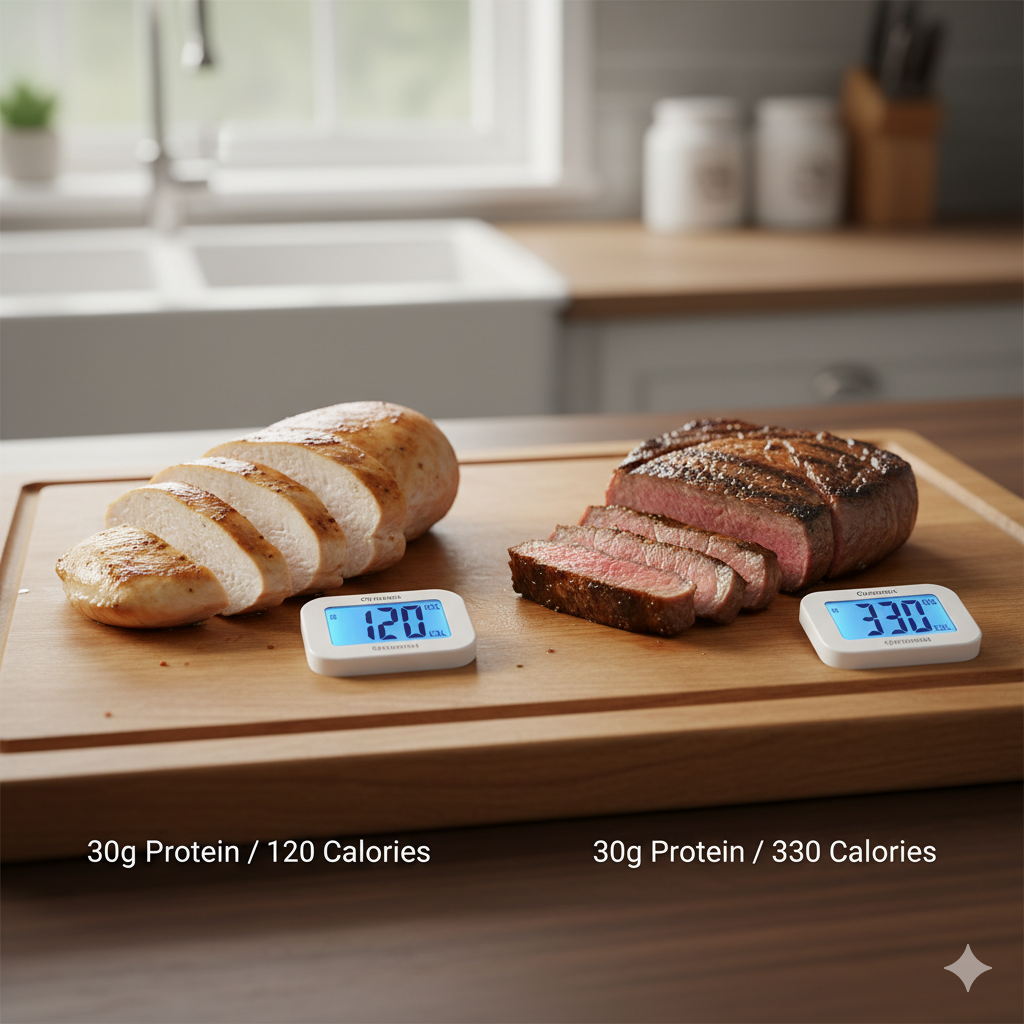
To achieve this without overshooting calories, you must prioritize lean protein sources.
- High-Fat Proteins: Steak, 80/20 ground beef, whole eggs. (These are fine, but their fat content adds up very quickly).
- Lean Proteins: Chicken breast, turkey breast, venison, cod, egg whites, whey protein powder, non-fat Greek yogurt.
Step 2: Find Your True Maintenance Calories
You can’t create a deficit until you know your starting point. Online calculators are useful, but they are only a ballpark guess. You must find your personal maintenance level.
Here’s how:
- Use an online TDEE (Total Daily Energy Expenditure) calculator as your starting estimate.
- Eat exactly that number of calories every single day for one full week.
- Weigh yourself every morning (after using the restroom, before eating) and track the weekly average.
Do not panic over daily fluctuations. Your weight can jump up or down 3-5 pounds based on water, salt intake, food volume, or if you’ve gone to the bathroom. The daily number is just noise; the weekly average is the data.
- If your average weight stayed the same, you found your maintenance.
- If your average went up, your maintenance is lower.
- If your average went down, your maintenance is higher.
Step 3: Create a Slight and Sustainable Deficit
This is the secret. A common mistake we observe is cutting calories too aggressively.
Do not cut 1,000 calories.
Start with a small, manageable deficit of 300-500 calories below your true maintenance.
This small cut is enough to trigger fat loss but not enough to send your body into a panic. It allows you to lose fat while keeping energy high, performance in the gym strong, and muscle tissue protected.
Your Goal: Aim to lose no more than 1% of your body weight per week. For most people, this is a very reasonable 1-2 pounds. This is the sustainable rate of fat loss, not just weight loss.
Step 4: “Milk the Deficit” and Master the Plateau
This is where you win.
You stay at that modest 300-calorie deficit for as long as it works. Don’t change anything as long as the weekly average on the scale is trending down.
- The Crash Dieter: Starts at an 1,800-calorie deficit. They plateau in 2 weeks, starving, with no energy. To lose more, they’d have to cut to 1,500 calories, which is a malnourished state. They quit.
- The Pro Dieter: Starts at a 2,500-calorie maintenance and cuts to 2,200. They lose 1 pound a week for six weeks. Finally, their weight stalls for a full week.
Now, instead of panicking, they have options. They make one small adjustment:
- Option A: Reduce calories by another 100-150.
- Option B: Add 20 minutes of cardio or 2,000 more steps per day.
They “milk” this new deficit for another 3-4 weeks. This slow, methodical titration is the key. You are making the smallest possible change to get the desired result, which leaves you more “room” to make cuts later.
Building Your Plate: A Simple Macro Framework
While calories are king, macros matter for body composition. A common starting point for a fat-loss phase is:
- 40% Protein
- 40% Carbohydrates
- 20% Fat
This is just a general framework. The key is that your protein stays fixed (at 1g/lb) and your fat stays at a baseline (around 20-25% of calories) to support hormone production.
The macronutrient you will primarily adjust to create your deficit is carbohydrates.
Carbs are your body’s preferred fuel source for performance. You keep as many carbs in your diet as possible while still losing fat. This is how you keep training hard and preserving muscle. When you need to cut calories further, you’ll typically pull from starchy carbs (rice, potatoes) or calorie-dense fats (like oils and dressings) first.
Your Toolkit: Tracking, Movement, and Key Supplements
The Habit of Tracking
You can’t manage what you don’t measure. For this process to work, you must be intimately aware of what you’re ingesting.
If you put it in your mouth, you count it. This includes sauces, drinks, and oils.
At first, this is cumbersome. You’ll need an app like MyFitnessPal or MacroFactor and a food scale. But after a few weeks, it becomes habitual. You’ll be able to look at a piece of chicken and know, “That’s about 6 ounces and 40 grams of protein.” It’s an arduous skill at the start, but it’s a skill you’ll have for life.
The “Non-Exercise” Advantage: Nutrient Partitioning
You don’t need to destroy yourself with cardio. In fact, a simple walk can be one of your most powerful fat-loss tools.
Going for a 15-20 minute walk after your meals is an incredibly potent way to manage blood glucose. In our clinical experience, it can be more effective than some oral medications at shuttling nutrients into the muscle.
You’re not doing it to “burn off” the meal. You’re doing it to improve nutrient partitioning—telling your body to store those carbs in your muscles as glycogen (fuel) rather than as body fat.
The One Supplement That Truly Performs
The supplement industry is mostly hype, but one compound stands above all else for performance: Creatine Monohydrate.
Many people (especially women) avoid it because they believe it causes “bloating.” This is a misunderstanding. Creatine pulls water inside the muscle cell. This is a good thing. It makes the muscle look fuller and, more importantly, improves its performance and strength.
It is anti-catabolic, helps you sustain training performance (which preserves muscle), and has a host of neurological benefits. It is hands-down the most effective, well-researched, and safest supplement for anyone looking to improve their body composition.
🩺 A Quick Note on Your Health
This guide is for informational purposes only and does not constitute medical advice. The strategies discussed are based on principles from competitive physique athletics. Before making any significant changes to your diet or exercise regimen, please consult with a qualified healthcare professional or a registered dietitian to ensure it is appropriate for your individual health needs and goals.