You’ve followed the rules. You’ve counted the calories, endured the bland meals, and spent hours on the treadmill. Yet, the scale remains stubbornly fixed, and the reflection in the mirror doesn’t match the effort you’re putting in. The simple formula of “calories in, calories out” feels like a broken promise, a puzzle with a missing piece.
This cycle of effort, frustration, and disappointment is exhausting. It makes you question your own body, wondering if your metabolism is uniquely broken or if you’re just missing some secret that everyone else seems to know. You start to believe that achieving a healthy, lean physique is a battle of deprivation you’re destined to lose.
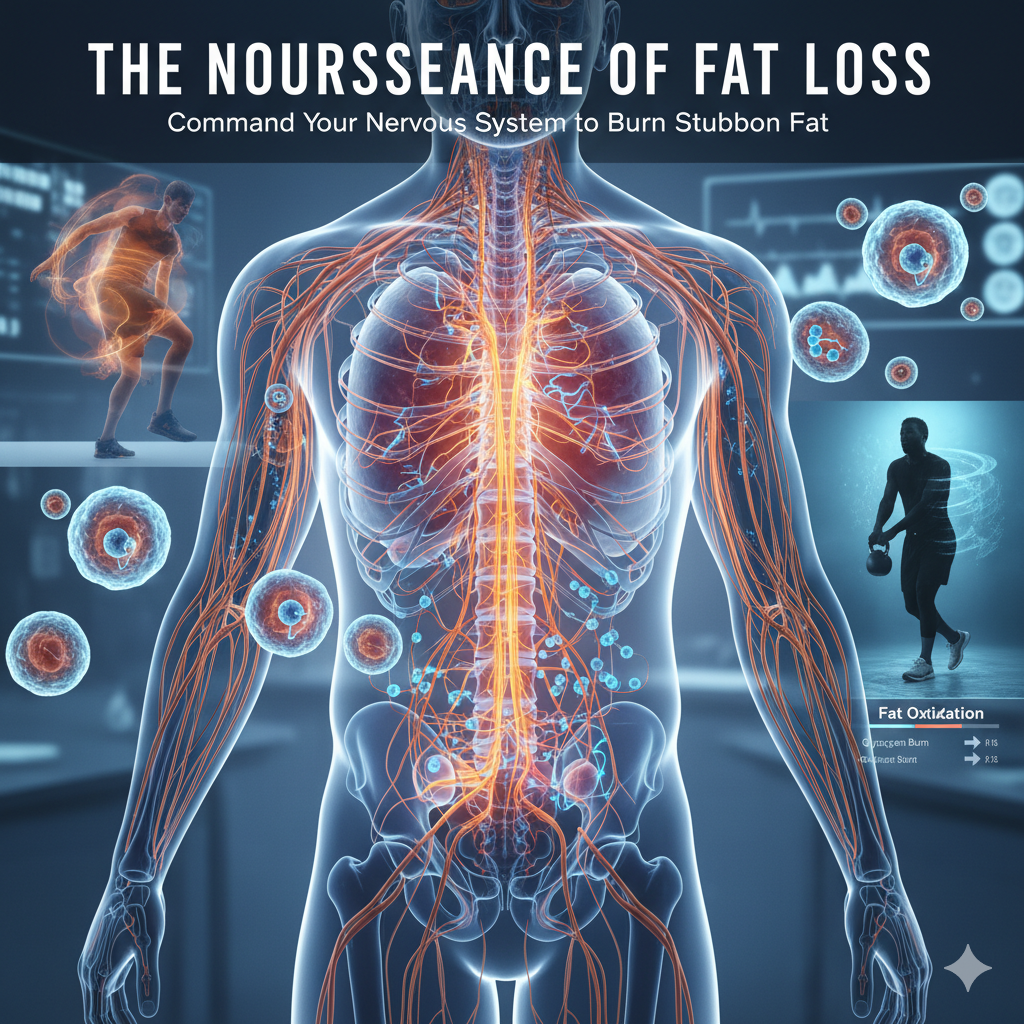
But what if the most powerful lever for fat loss has been overlooked in mainstream advice? What if the master control switch isn’t just in your diet or your workout, but in the complex electrical wiring that runs your entire body? The truth is, your nervous system is the silent commander of your metabolism. It sends direct signals to your fat cells, telling them when to store energy and when to burn it for fuel. This article is your new blueprint. It’s a science-backed guide to activating these neural pathways and turning your body into a more efficient fat-burning machine. Ready to learn how to send the right signals?
A Note on Your Health (YMYL Disclaimer): The information provided here is for educational purposes only and is based on scientific research. It is not a substitute for professional medical advice. Always consult with a qualified healthcare provider before making any significant changes to your diet, exercise routine, or supplement regimen, especially if you have pre-existing health conditions.
The Unseen Controller: Why Your Nervous system is the Key to Fat Loss
For decades, the conversation around fat loss has been dominated by diet and exercise in isolation. We treat the body like a simple combustion engine. But this misses the bigger picture.
Your nervous system—your brain, spinal cord, and the vast network of nerves connecting to every organ and tissue—is the master controller. It dictates every process, and fat metabolism is no exception.
Beyond “Calories In, Calories Out”
Let’s be clear: the principle of energy balance is fundamental. If you consistently ingest more calories than you burn, you will gain weight. There is no escaping this law of thermodynamics.
However, the “calories out” side of the equation is not a static number. It’s a dynamic, adaptable process heavily influenced by neural signals.
Here’s the deal: Your nervous system can dramatically increase or decrease the rate at which you burn calories. By understanding how to influence it, you gain a powerful advantage that goes far beyond simple calorie counting.
The Two-Step Process: Mobilization and Oxidation
Burning body fat isn’t a single event. It’s a two-part process, and your nervous system is the key that unlocks both stages.
- Fat Mobilization (Lipolysis): Think of your stored body fat (adipose tissue) as money locked in a vault. Before you can spend it, you have to get it out. Mobilization is the process of unlocking the vault. Neurons connect directly to your fat cells and release a neurotransmitter called epinephrine (also known as adrenaline). This signal breaks down stored fat (triglycerides) into fatty acids, releasing them into the bloodstream.
- Fat Oxidation (Utilization): Once the fatty acids are circulating in your bloodstream, they need to be transported to other cells (like muscle cells) and burned for energy inside their powerhouses, the mitochondria. This is the “spending the money” phase. Epinephrine also plays a crucial role here, facilitating the conversion of these fatty acids into usable energy (ATP).
The game-changing insight from recent neuroscience is this: the most potent epinephrine for fat loss comes not from a general stress response, but from the local release by neurons directly connected to your fat stores. Your specific actions can target these neurons and accelerate this entire process.
Tool #1: Activate Fat-Burning Neurons with Subtle Movement (NEAT)
One of the most powerful ways to stimulate this local epinephrine release is through movement. But we’re not just talking about a 60-minute gym session.
This is about Non-Exercise Activity Thermogenesis (NEAT).
In the 1960s and 70s, researchers Rothwell and Stock made a fascinating observation. They studied individuals who over-ate but didn’t gain weight. Their secret wasn’t a “fast metabolism” in the traditional sense.
It was constant, subtle movement. They were fidgeters.
Sound familiar? Bouncing your knee, pacing while on the phone, standing up frequently—these small, almost unconscious movements trigger a steady release of epinephrine from the neurons innervating your fat. This low-level activity constantly mobilizes and oxidizes fat throughout the day.
Your Actionable Protocol: Become a “Fidgeter”
Instead of thinking of calorie burning as something that only happens during formal exercise, integrate NEAT into your entire day.
- Pace: When you take a phone call, stand up and walk around.
- Stand: If you work at a desk, set a timer to stand up and stretch every 30 minutes. A standing desk can be a great investment. [Internal Link to: Benefits of a Standing Desk for Health].
- Fidget: Don’t suppress the urge to tap your foot or bounce your knee. These seemingly minor movements add up to a significant caloric burn over time.
For those averse to traditional exercise, intentionally increasing NEAT can be a highly effective entry point to fat loss without ever setting foot in a gym.
Tool #2: Harnessing Cold and Shiver for Accelerated Thermogenesis
If fidgeting is the low hum of fat burning, shivering is a powerful roar. Shivering is one of the most potent stimuli for epinephrine release directly into fat tissue.
And the most reliable way to induce shivering is through cold exposure.
White Fat vs. Brown Fat: Your Body’s Energy Burner
To understand why this is so effective, you need to know about two types of fat:
- White Adipose Tissue (WAT): This is the primary storage fat we typically want to lose. It’s not metabolically active on its own.
- Brown Adipose Tissue (BAT): This is “good” fat, packed with mitochondria. Its sole purpose is to burn energy to generate heat (thermogenesis). It’s primarily located between your shoulder blades and on the back of your neck.
Cold exposure does two incredible things: it activates existing brown fat and can even help “beige” white fat, making it more metabolically active.
The Critical Mistake Most People Make with Cold Exposure
Many people hear “cold exposure” and think a quick, 30-second cold shower is enough. They grit their teeth, get out, and feel accomplished.
But they’re missing the most important part.
The goal isn’t just to get cold; it’s to induce shivering. A 2021 study in Nature revealed that the muscle contractions from shivering release a molecule called succinate. Succinate then travels to your brown fat and acts as a powerful activator, dramatically increasing thermogenesis and overall calorie burn.
If you adapt to the cold too quickly and stop shivering, you lose this powerful metabolic benefit.
Your Actionable Protocol: The Shiver Cycle
To leverage cold for fat loss, you need to trigger a shiver response intentionally.
- Find Your Temperature: Use a cold shower, cold plunge, or ice bath. The temperature should be uncomfortably cold but safe—enough to make you want to get out. For some, this is 60°F (15°C); for others, it may be lower. Proceed with caution and never do this alone.
- Initiate the Shiver: Stay in the cold water until you feel the first genuine, uncontrollable shivers begin. This might take 30 seconds or a few minutes.
- Get Out (Don’t Dry Off): Once you start shivering, get out of the water. Do not towel off. The evaporating water on your skin will enhance the cold sensation.
- Wait: Stand for 1 to 3 minutes, allowing the shivering to continue or even intensify.
- Repeat: Get back into the cold water. You will likely start shivering much faster this time. Stay in for another 1-3 minutes.
- Perform 2-5 Cycles: Aim to complete 2 to 5 rounds of this “in and out” protocol, 2 to 4 times per week.
This method prevents full cold adaptation and maximizes the succinate-driven activation of your brown fat.
Tool #3: Strategically Time Your Exercise for Maximum Fat Oxidation
While NEAT and shivering are powerful, formal exercise remains a cornerstone of health and fat loss. But how and when you exercise can dramatically change how much body fat you burn.
HIIT vs. Steady-State: It’s All About Adrenaline
Let’s categorize exercise by intensity, as this relates directly to adrenaline release:
- Sprint Interval Training (SIT): All-out bursts ( >100% VO2 max) for 8-30 seconds. Think hill sprints. This causes a massive adrenaline surge.
- High-Intensity Interval Training (HIIT): Sub-maximal bursts (80-100% VO2 max) for 60-240 seconds. Think intense weight training sets or kettlebell swings. This also causes a significant adrenaline spike.
- Moderate-Intensity Continuous Training (MICT): Steady-state cardio (40-60% VO2 max) for 20-60+ minutes. This is often called “Zone 2 Cardio.” Adrenaline release is low and steady.
The Fasted Training Advantage: When It Matters Most
The debate over “fasted vs. fed” cardio is endless. Here’s what the science says for fat loss:
When you exercise, your body first burns stored sugar (glycogen). Only when glycogen runs low does it significantly ramp up fat oxidation.
- For moderate-intensity cardio (MICT), this switch-over point happens around the 90-minute mark. If you ate beforehand, your elevated insulin levels will suppress fat oxidation even longer.
- But for high-intensity training (HIIT/SIT), you burn through glycogen much faster. This means the switch-over to preferential fat burning happens much, much earlier.
This creates a powerful opportunity.
Your Actionable Protocol: The “High-to-Low” Fasted Workout
To maximize fat burning, perform this protocol 3-4 times per week, preferably in a fasted state (e.g., in the morning before your first meal).
- Start with High Intensity: Begin with 20-40 minutes of intense exercise. This could be weightlifting, kettlebell circuits, or sprints. This will rapidly deplete glycogen stores and spike adrenaline.
- Follow with Low Intensity: Immediately after your high-intensity work, transition to 20-40 minutes of moderate-intensity cardio (MICT). This could be a brisk walk on an incline, a light jog, or cycling.
- The Result: You enter the cardio portion already in a glycogen-depleted, high-adrenaline state. Your body has no choice but to tap into your fat stores for fuel at a much higher rate than it normally would.
The bottom line? If your goal is performance, fuel your workouts. If your primary goal is fat loss, using this high-to-low fasted protocol is a neurologically sound strategy.
Tool #4: Compounds That Amplify Your Efforts
Behavior and nutrition are the foundation. But certain compounds can further enhance the neural and metabolic processes we’ve discussed.
A Word of Caution: Behavior First, Supplements Second
There are no magic pills. Supplements cannot outwork a poor diet or sedentary lifestyle. Use these tools to amplify the results of your hard work, not to replace it.
Caffeine: The Go-To Pre-Workout Fat Burner
Caffeine is a well-established performance enhancer that works primarily by increasing the release of epinephrine.
- Dosage: 100-400 mg. This is roughly 1-3 cups of standard coffee.
- Timing: 30-40 minutes before your workout.
- Effect: Caffeine can increase the percentage of fat you oxidize during exercise of any intensity.
Yerba Maté and the GLP-1 Pathway
Yerba maté is a South American tea that offers a unique benefit. It increases a hormone called GLP-1, which works in the glucagon pathway. Glucagon is essentially the opposite of insulin; while insulin promotes energy storage, glucagon promotes the use of stored energy.
By increasing GLP-1, yerba maté shifts your metabolism toward greater fat oxidation, both at rest and especially when consumed before exercise.
A Note on Pharmaceuticals and Glucose Control Agents
The GLP-1 pathway is so effective that it’s now the target of powerful prescription drugs like semaglutide, used for treating diabetes and weight loss. These are the “heavy artillery” and should only be explored under the strict guidance of a physician.
Other compounds like berberine and metformin (a prescription drug) work by powerfully reducing blood glucose, which in turn keeps insulin levels low. Since high insulin inhibits fat oxidation, maintaining low insulin levels creates a more favorable environment for fat burning.
Your Path Forward: From Knowledge to Action
We began with the frustration of a seemingly simple formula that wasn’t working. Now, you see the missing piece. The “calories out” equation isn’t just about logging minutes on a machine; it’s about sending the right signals through your nervous system.
The ultimate takeaway is this: your nervous system is the conductor of your metabolic orchestra. By using tools like NEAT, strategic cold exposure, high-to-low intensity training, and supportive compounds, you learn to direct the music. You are no longer just a passenger; you are in command.
Understanding these principles is the first crucial step. The next is to take consistent, intelligent action.