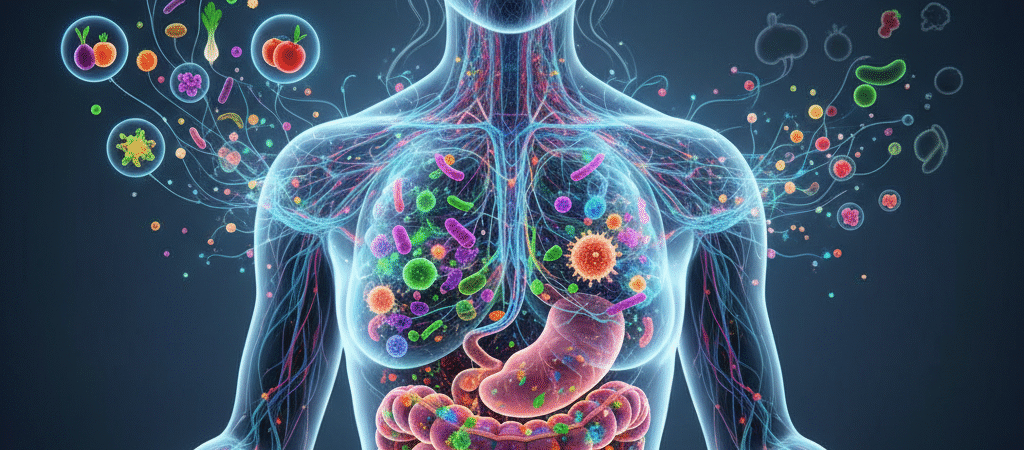
When you hear “gut health,” your mind probably jumps to uncomfortable symptoms: bloating, gas, or digestive irregularity. For years, we’ve treated the gut as a simple plumbing system. But what if that persistent brain fog, low energy, and even your mood swings aren’t separate issues, but are actually a direct signal from your gut?
Sound familiar? You’re not alone. Many people try to fix these problems in isolation—more coffee for fatigue, restrictive diets for bloating—only to end up frustrated. The agitation grows as you realize that despite your best efforts, you still don’t feel 100%.
Here’s the truth: Your gut is your body’s “second brain.” An imbalanced gut microbiome can silently sabotage your immune system, hijack your hormones, and cloud your mental clarity.
This is not another post about a “miracle cure” or a “3-day detox.” This is your definitive, evidence-based guide. We will cut through the social media noise and explore the profound science linking your gut to your entire body. We’ll give you a practical, actionable plan—5 things to add and 5 things to avoid—to rebuild your gut health from the ground up. If you’re ready to not only “poo better” but also think and feel better, keep reading.
What is “Gut Health,” Really? (It’s Not Just Your Stomach)
At its simplest, your gut is the gastrointestinal (GI) tract—a long tube that starts at your mouth and ends at your anus. Its primary job is to break down food, absorb nutrients, and excrete waste.
But that’s not the whole story.
The real star of the show is your gut microbiome: a vast, complex ecosystem of trillions of microorganisms, including bacteria, fungi, and viruses, that live primarily in your colon.
So, what does “healthy” mean in this context?
A healthy gut is defined by two key things: balance and diversity. It’s not about “good” bacteria vs. “bad” bacteria; it’s about having a vast variety of different species working together in harmony. When this ecosystem is out of balance (a state called “dysbiosis”), it can trigger a cascade of problems far beyond your digestive tract.
The Gut-Brain Axis: Your “Second Brain” Is Talking
You’ve felt “butterflies in your stomach” when you were nervous. You’ve had a “gut-wrenching” feeling about a tough decision. This isn’t poetry; it’s physiology. There is a powerful, bi-directional communication highway between your gut and your brain, known as the gut-brain axis.
And here’s the most fascinating part: Your gut is constantly sending more messages to your brain than your brain is sending to your gut. It’s the chattiest organ you have. This communication happens in three primary ways:
1. The Chemical Connection (Your Mood)
Your gut microbiome is a veritable neurotransmitter factory. In fact, an estimated 95% of your body’s serotonin—the “happy hormone” that regulates mood, sleep, and happiness—is produced in your gut. Your gut bugs also produce other critical chemicals, like dopamine and GABA, that directly influence your mental state.
2. The Hormonal Connection (Your Stress)
Your gut bacteria interact with a complex system in your brain called the HPA axis (Hypothalamus-Pituitary-Adrenal). This is your central stress-response system. Research shows that the composition of your gut microbiome can directly influence how your body responds to stress and regulates cortisol (the “stress hormone”). [External Link to: A PubMed study on the HPA axis and gut microbiome].
3. The Physical Connection (The Vagus Nerve)
The vagus nerve is a massive, physical “data cable” that runs from your brain stem all the way down to your colon. It’s the main highway of your parasympathetic nervous system (your “rest and digest” state). Your gut microbes can send signals directly up this nerve to your brain, influencing everything from your heart rate to your mood.
The Gut-Immune Link: Your First Line of Defense
Here’s a staggering fact: Over 70% of your body’s entire immune system is located in your gut.
Think of your gut lining as a high-security border. It’s only one cell thick, but it’s responsible for deciding what gets into your bloodstream (nutrients) and what stays out (toxins, pathogens, undigested food).
Your gut bacteria are the border guards. They are in constant communication with your immune cells, “training” them to tell the difference between a friend (a piece of broccoli) and a foe (a harmful virus). A diverse, healthy microbiome strengthens this border, leading to a more robust and balanced immune response.
The Actionable Plan: 5 Things to ADD for a Thriving Gut
Forget the quick-fix “detoxes” you see on social media. As in our clinical experience, sustainable gut health is built on foundational principles, not fads. Start by adding these five things.
1. Aim for 30 Different Plants Per Week
This is perhaps the single most important rule for gut diversity. Different species of bacteria like to eat different types of plant fiber. To feed your entire “team,” you need to give them a variety of foods.
“Plants” includes more than just lettuce:
- Vegetables (broccoli, carrots, spinach, onions)
- Fruits (berries, apples, bananas, oranges)
- Legumes (beans, lentils, chickpeas, tofu)
- Whole Grains (oats, quinoa, brown rice, barley)
- Nuts & Seeds (almonds, walnuts, chia seeds, flaxseeds)
- Herbs & Spices (garlic, ginger, turmeric, parsley)
Pro-Tip: Don’t get overwhelmed. 30 a week is just 4-5 different plants per day. A bowl of oatmeal (1) with blueberries (2), walnuts (3), and chia seeds (4) already gets you four points at breakfast.
2. Prioritize Variety Over Consistency
In the fitness world, you’re often told to eat the same consistent meals for easy tracking. For gut health, the opposite is true.
A common mistake we observe is eating the same “healthy” foods every single day. That “healthy” chicken, rice, and broccoli meal? It’s great, but if you eat it daily, you’re only feeding the specific bacteria that like chicken, rice, and broccoli. You’re starving all the others.
More food variety = more microbiome diversity. Try swapping your apple for a pear, your brown rice for quinoa, or your almonds for pumpkin seeds.
3. Get 30 Grams of Fiber Daily
Most people in the Western world eat less than half the recommended amount of fiber. Fiber is a prebiotic—it’s not for you, it’s food for your gut bacteria. When your gut bugs ferment (eat) this fiber, they produce short-chain fatty acids (SCFAs), which are powerful anti-inflammatory compounds that fuel your gut lining and support your health.
How to get there:
- Aim for 5+ servings of fruits and vegetables a day.
- Include whole grains in at least two meals.
- Snack on nuts, seeds, and fruit.
4. Consider a High-Quality Probiotic
Probiotics are live microorganisms (like bacteria) found in supplements or fermented foods that are intended to maintain or improve your gut’s “good” bacteria.
A quick disclaimer: The evidence for probiotics is still evolving. However, specific strains have shown promising results in clinical studies. For example, some studies have shown that certain probiotic strains can help reduce psychological stress and lower measurable cortisol levels.
Expert Tip: If you choose a supplement, look for evidence-based strains. Be mindful of manufacturing and expiry dates—a bottle of live bacteria that’s been sitting on a warm shelf for months may not be effective.
5. Eat Two Portions of Oily Fish Per Week
Your gut loves long-chain omega-3 fatty acids. These healthy fats, found in oily fish, help promote the growth of beneficial bacteria and are powerfully anti-inflammatory, both in the gut and the brain.
As one expert memorably put it: “Not eating oily fish is like taking 25% of the bricks out of your house and replacing them with polystyrene.”
- Good sources: Salmon, mackerel, sardines, anchovies.
- Note: Tuna and cod are not considered oily fish.
- Vegetarian/Vegan? You can get omega-3s from flaxseed, chia seeds, and walnuts, or consider a high-quality, algae-based omega-3 supplement.
The 5 Common Traps: What to AVOID or Reduce
This isn’t about perfection; it’s about awareness. You don’t have to eliminate these forever, but reducing them can have a massive impact.
1. Excessive Red Meat
While red meat is a great source of protein, the metabolites (breakdown products) from excessive red meat consumption are associated with a higher risk of cardiovascular disease and bowel cancer.
The Guideline: The World Cancer Research Fund recommends limiting red meat to no more than 350-500 grams (cooked weight) total per week.
2. Ultra-Processed Foods (UPFs)
This is basically anything that comes in a packet with a long list of ingredients you can’t pronounce—sausages, crisps, sugary cereals, and many pre-made meals.
The problem isn’t just the sugar or fat. It’s the additives, preservatives, and emulsifiers. These chemicals are designed to stop bacteria from growing in the food (to give it a long shelf life). When you eat them, they can do the same thing to your gut bacteria.
Emulsifiers, in particular (found in many protein shakes, plant milks, and ice creams), are thought to disrupt the tight junctions of your gut wall, potentially leading to inflammation.
3. Artificial Sweeteners
This one is frustrating. You drink a “diet” soda thinking you’re making the healthy choice. Unfortunately, your gut may not agree.
When you taste something sweet, your body anticipates sugar. It can trigger an insulin response, getting ready for a sugar load that never comes. This can, ironically, make you hungrier and disrupt your metabolic health. [Internal Link to: The Truth About Artificial Sweeteners].
4. Social Media Fads and “Detoxes”
Be very wary of “Gut Tok” trends and juice cleanses. These are almost never promoted by qualified medical professionals.
- Juice Cleanses: These “detoxes” actually deprive your body of crucial nutrients and, most importantly, all the fiber from the fruits and vegetables.
- Gluten-Free Diets: Unless you are in the 1-2% of the population with celiac disease or a diagnosed non-celiac gluten sensitivity, there is no significant health benefit to cutting out gluten. In fact, many whole grains that contain gluten are excellent prebiotics.
5. Relying Only on Calorie Counting
Calories do not equal nutritional value.
A 340-calorie portion of fast-food fries and a 340-calorie meal of salmon, roasted vegetables, and quinoa have vastly different impacts on your gut microbiome, inflammation, and health.
Furthermore, calorie labels are legally allowed to be up to 20% inaccurate. Your body also doesn’t absorb all calories the same way (e.g., you absorb fewer calories from whole nuts than from nut butter).
A better approach: Shift your focus from calories to nutritional density and listening to your body’s physical hunger cues.
Your Gut is the Foundation of Your Health
Feeling foggy, stressed, and bloated isn’t your new normal. It’s a sign. It’s your “second brain” telling you that its foundation—the microbiome—needs support.
Improving your gut health isn’t about a restrictive, short-term diet. It’s about a long-term strategy of abundantly adding diversity and mindfully reducing disruption. The path to a clearer mind, a stronger immune system, and more vibrant energy starts on your plate.